Saturday, January 31, 2009

Obama Gutting the Navy

CDR Salamander asks (at his place)

$55 billion? What does the Navy throw on the alter? At the low end, I would think that we will have to eat at least 30% of that - let's call it $18.3 billion that needs to go as a baseline.

His question at the USNI blog gets right to the point: Which child do you sell first?

Lets check the numbers.

According to the 2009 budget (Figure 2 on page 1-14), the planned Navy Department top line budget was $152.8 billion. The 10% cut if applied to all of the services would mean $15.3 billion, taking the budget down to $137.5 billion. Phibian's $18.3 billion would put the top line at $134.5 billion. The lowest Navy top line in the Bush administration budgets was $140.6 billion (constant FY09 dollars). Capabilities will have to be cut. Let's assume that Phibian got it right and the $18.3 number is the real deal. The question is, where?

I'll assume that Marine Corps personnel accounts will go up by 6% to meet President Obama's stated goal of increasing the ground forces, and that Navy personnel accounts will go down to pay that bill. That will take 2.5% out of the active account and 10% out of the reserves. Combined with the pay rate increases, a 2.5% funding cut is probably a 6% end strength reduction, from the current 337K down to about 311K.

Next, whack 25% from MILCON and housing accounts. This saves us $1.2 billion, but will be nearly impossible to sell in a Congress dependent on those accounts.

Six percent increases in Marine Corps O&M (to support the 6% increase in personnel expenses) mean we need to cut 20% from Navy Reserve O&M and 10% from the active side. This results in a net savings of $3.4 billion (about 10%), so now our top line budget is down by $4.6 billion. This leaves $13.7 billion that must come from either procurement or R&D funds. Twenty percent from R&D would be about $3.9 billion, so the remaining $9.2 billion has to come out of procurement.

Level loading that $9.2 billion across the procurement accounts, we would need to cut each by 24%. That means the cuts would be broken down along the following lines:

  • Aircraft - $3.5 billion

  • Shipbuilding and Conversion - $3.1 billion

  • Other Procurement - $1.3 billion

  • Weapons - $0.9 billion

  • National Defense Sealift Fund - $0.5 billion

  • Marine Corps - $0.4 billion

  • Ammunition - $0.2 billion

Achieving these reductions is going to be very difficult, and will disrupt ongoing contracts in significant ways. Take aircraft procurement as an example. To cut $3.5 billion, we could eliminate all of the non-combat aircraft, and still have to cut 40 out of 155 combat aircraft. Spares and Support equipment costs would probably have to go up because of the additional wear and tear on the existing fleet.

Shipbuilding and Conversion is probably even harder to cut than aircraft. The unit quantities are so low right now that deferring a ship for a year just increases its net cost. The FY09 new construction account was $11.1 billion for seven ships. Killing the FY10 DDG (either flavor) and the 10 th LPD 17 is probably the only viable option to get $3.1 billion.

We need $1.3 billion out of OPN. The biggest lines available there are ship support equipment ($1.7 billion) and communications equipment ($2 billion). A lot of those dollars are related to shipbuilding, so it may be that they come down naturally if we cut ships. $900 million from weapons procurement can be approached if we cut all of our 2009 tactical missile and torpedo purchases in half, or if we forgo a year of Trident II upgrades and make moderate cuts to other programs.

Whatever approach our naval leadership takes in response to the president's direction, it is going to be painful. Making cuts like these while the military is still fighting a war is irresponsible if not dangerous. And as I pointed out in my previous post, it is a false savings. Eliminating billions from defense procurement only to shift those funds into unemployment accounts is a net reduction in the productivity of the American economy, and a huge cut to the military power of the United States.

To the good Commander, I'm afraid the answer may be "all of them."

Defense Budget Cut 10%

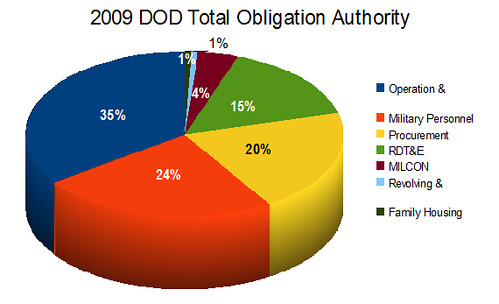
The problem: cut 10% from the military budget. How is it possible to slash $55 billion from our national defense accounts? The president has stated as one of his goals the need to increase the size of the Army and Marine Corps. If that's to be realized, then his staff will provide some direction to Defense on how the cuts are to happen. I suspect they will think in terms of budget categories rather than services first. The distribution of Total Obligation Authority (TOA) may be able to give a starting point. Operations and Maintenance and Military Personnel make up 59% of the budget, so if they are left essentially unchanged the bulk of the cuts will fall to RDT&E and Procurement. (click for larger image)

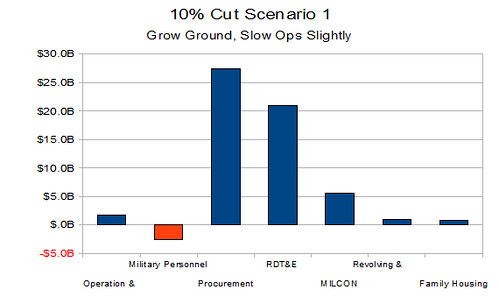
I took a swag at one scenario, where the ground force growth increases personnel funding by about 2% in 2010 and O&M goes down by about 1%. To get to a $55 billion cut with those assumptions, each of the remaining accounts has to go down by 26%. In that case, we are likely to see $27 billion out of procurement and $21 billion out of RDT&E. (click for larger image)

What's the impact of that size cut? Twenty-six billion dollars out of the procurement budget, based on 2007 numbers, would eliminate 62% of Lockheed, 81% of Northrop Grumman, 95% of General Dynamics, or 122% of Raytheon. Add on half of the RDT&E cut (since the government labs do quite a bit of research), and you could put half of Raytheon out of work again. Looking at the number of people employed by these companies, that size cut will result in the elimination of between 122,000 and 137,000 jobs.

It's a good thing the “stimulus” package adds $36 billion in expanded unemployment “benefits” to make up for the $36 billion in valuable work that will be lost here. I know how important it is for the Democrats to make us all dependent on the government, and moving those highly-skilled defense workers from productive careers to the dole is just the ticket.

Monday, December 22, 2008

GAO Reports on Weapon Systems

In much discussion of US weapons systems, the Government Accountability Office is often cited as a source of information on costs, risks, and performance. For the basic facts, I think this is a good thing; they have access to data from multiple primary sources, and present it clearly.
That said, I have some concerns about their ability to present program assessments - their opinions - without spin. All too often, a report seems to lean toward the conclusions desired by the Congressman who requested it. Reports favorable of weapons systems acquisition programs seem rare, probably because no one really cares when things are going well.
My concern lead me to dig into the GAO archives, searching along the lifetime of the Aegis Weapon System since it has been in service for so long and is regarded as quite successful. What I found was quite interesting. First up, a June 12, 1980 report of the Comptroller General to Congress on Issues Identified in 21 Recently Published Major Weapon System Reports. This summary, written whe the Aegis weapon system was in limited production and the then-DDG-47 lead ship had started construction, expressed concerns about several key areas:

Foremost are Aegis availability problems, software reliability, ship weight, reduced antisubmarine warfare capability, and ship vulnerability.

The concern about ASW was the most interesting of the bunch, given the current debates about Littoral Combat Ship capabilities:
REDUCED DDG-47 ANTISUBMARINE CAPABILITY
The DDG-47 will not have its planned full antisubmarine warfare capability when it is deployed. Neither the Tactical Towed Array Sonar (TACTAS) nor the LAMPS III helicopter is yet in production and will not be available until the follow ships are built.

The next report, Opportunities for Improving Management of Navy's Aegis Cruiser Program, was issued in February 1981. This report concluded that "serious questions surround [the Aegis Weapon System's] readiness to support naval carrier battle groups." This conclusion appears to be drawn based on the facts that the full system had never before been deployed, that "much of the weight allowance for the planned weapon system [had] been consumed," and that the program office had selected a power inverter for the first ship.
A report in February 1983 concluded that "the AEGIS combat system was not adequately tested before it was commissioned in January 1983" and notes that such testing was scheduled for May-September of that year.
Cost and schedule issues with the DDG-51 class were detailed in January 1990. Between the 1983 report on combat system testing and the cost issues for DDG-51, I found nothing on issues with the capability of the Aegis cruisers.
I think this is interesting, because it shows that given the right set of conditions, the Navy was able to manage and deliver a robust capability, even when the watchdogs found fault with the design and implementation of the first in class. Lets hope that they can replicate those conditions for LCS, and provide the fleet with a ship that performs its assigned missions remarkably well and with little publicity.

Saturday, December 06, 2008

Sunday, November 16, 2008

Piracy!

It seems that to catch a pirate, one must think like a pirate. The Coast Guard seems to have taken that a step further, and their blogging team for the Valour-IT competition is acting like a pirate crew. They've hijacked the other teams' thermometers, and they are demanding ransom.
Fortunately, you can still track (and build on) the superior might of the Navy team via this:


One wonders if the Commandant is paying attention to the creativity and ingenuity being displayed by "his" supporters. Their actions, in the spirit of a friendly competition

Tuesday, November 11, 2008

Valour-IT

As I've done each of the last several years, I am supporting the Valour-IT fund drive. This project provides laptops so that injured service members can reconnect to the world outside of their medical facilities.

The project came from the experience of Major Chuck Ziegnefuss, and armor officer and military blogger who was wounded in Iraq. Chuck, who blogs at From my position... On the way!, has said that using a voice-activated laptop "was the first time I felt whole since I’d woken up wounded in Landstuhl."

Many soldiers, sailors, airmen and Marines have been helped by this program over the years, but there is still a need for more funds. Please support our Navy team by clicking the image below and making a tax-deductible donation. Our goal is $25,000, and we are only one tenth of the way there.


Monday, October 27, 2008

Cost Growth in Shipbuilding

It seems that western navies are not the only ones having trouble keeping costs under control. According to an opinion piece in RIA Novosti, "Project 20380 ship - the corvette Steregushchy - has gone up in price during its construction from 1.8 billion to 5 billion rubles" -- 177% over the initial estimate.

Friday, October 10, 2008

Piracy a legal problem?

Over at Information Dissemination, Galrahn has an informative and interesting post about one of my favorite subjects: A Team Effort at Sea, A Legal Problem Looms. Russia has sent a frigate to the Gulf of Aden to work with the US and EU in combating piracy. Galrahn commends the cooperative approach, but points out that there is a significant question of what to do with the pirates.

The world is in desperate need of a legal framework for dealing with pirates captured. France has a legal framework for dealing with pirates, and several Somalians will serve time in a French prison because France has the political will to carry that obligation without an international legal system. Many in the world require a more international legal approach, and the foundations for such a legal framework would come through international organizations like the United Nations.
Without the step of creating a legal body to serve as an enforcer of international law against piracy, whether it is conducted like war crimes tribunals or some other framework, response may indeed turn out to be inconsistent. The Russians may be more like France, and take prisoners home to face justice in a Russian court, but we have already seen the Danes release pirate prisoners on the beach.
If Americans have a serious desire to stop piracy, the action to be taken is political and begins in the UN. There is almost no public advocacy for this step, and it could be that Gitmo is a reason why this administration lacks the political will to call for such a system. Without that political action towards building an international legal system to deal with pirates, results may indeed be inconsistent.

The UN Convention on the Law of the Sea provides a framework for states to deal with this issue in Part VII, Article 105 (emphasis added).
On the high seas, or in any other place outside the jurisdiction of any State, every State may seize a pirate ship or aircraft, or a ship or aircraft taken by piracy and under the control of pirates, and arrest the persons and seize the property on board. The courts of the State which carried out the seizure may decide upon the penalties to be imposed, and may also determine the action to be taken with regard to the ships, aircraft or property, subject to the rights of third parties acting in good faith.

Unfortunately, Article 106 muddies the waters with this: "Where the seizure of a ship or aircraft on suspicion of piracy has been effected without adequate grounds, the State making the seizure shall be liable to the State the nationality of which is possessed by the ship or aircraft for any loss or damage caused by the seizure." This clause effectively ties the hands of the United States, since every "human rights" advocacy group will attempt to clog up the courts to fight for the "right" of the filthy pirates to steal from other people.
This problem, however, is not a legal one, per se. The U.S. Constitution grants the Congress the power (in Article I, Section 8), to "grant letters of marque and reprisal, and make rules concerning captures on land and water." Congress has, in fact, done so. For example, 18 USC 1651 states clearly that "Whoever, on the high seas, commits the crime of piracy as defined by the law of nations, and is afterwards brought into or found in the United States, shall be imprisoned for life." Section 1653 further clarifies how this applies to aliens engaged in piracy, and calls for the same penalty.
We have the legal means to deal with the issue. We don't seem to have the political will to enforce our own laws, which are well-supported by so-called international law in the case of pirates.

Tuesday, October 07, 2008

Mike on the Mend: In Memoriam

I mentioned a couple of weeks ago that my USNA classmate, Colonel Mike Stahlman, had been seriously injured while on duty in Iraq. Unfortunately, the best the Navy doctors in Bethesda could do was not enough; Mike passed this Sunday, with his wife Kim by his side.
I had not seen Mike in many years, but I find myself now remembering him as a Midshipman - full of energy, enthusiastic, a natural leader. I imagine that those qualities did not diminish with time.


Here's health to you and to our Corps
Which we are proud to serve;
In many a strife we've fought for life
And have never lost our nerve;
If the Army and the Navy
Ever look on Heaven's scenes;
They will find the streets are guarded
By United States Marines.


Semper Fi, Mike. You will be missed.

Tuesday, September 23, 2008

Mike on the Mend

I recently learned that a classmate, Col. Mike Stahlman, USMC, suffered a pretty severe head injury while on duty in Iraq. He's back in the states now, and recovering slowly with the help of the Navy docs and his family. A blog with information on his recovery ups and downs is being kept up by a family friend at Mike on the Mend.
Please say a prayer for Mike and his family. If your means allow, a fund has been set up to help the family through their ordeal. While the Marines are meeting most all of the family's needs right now, that may not always be the case.

Stahlman Family Fund
c/o Joe Matza
305 Glen Echo Lane, Unit N
Cary, NC 27518

Saturday, August 30, 2008

The future?

Speaker of the House
President of the Senate
Both women? Sounds fun!

Thursday, August 28, 2008

Force Structure Required to Execute the Maritime Strategy

I've been delayed a bit by real life in completing the assignment laid out by Galrahn at Information Dissemination, but now I can report some progress.
In my last post, I laid out the tasks required by the Maritime Strategy and the assumptions I would use in filling those tasks. The basic requirement is for two continuous forward deployed elements (WestPac and IO), continuous presence in partnership stations and other commitments, and the ability to win our nation's wars at sea while supporting efforts ashore.
For the forward deployed elements, I built CSGs and ESGs based on those we currently have, but reduced the slight excess in missile power found in some CSGs by adding a 5th-rate FFG of 32 cells in place of an extra DDG.


Based on my 2:1 assumption for continuous deployers, along with 85% operational availability, the force structure to support this commitment is 28.24 DDGs, 14.12 CGs, and 7.06 CVNs, SSNs, FFGs, LHDs, LPDs, and LSDs. (I'll deal with the fractional ships at the end of the analysis).

The next commitment I would address is the partnership stations, where we use various means of soft (and hard) power to influence events but don't need to be fighting battles. We still need some battle force missiles available in each of the regions, but nowhere near what the CSG or ESG require. I used existing commitments, along with some needs that I see, to define these six stations:

  • Standing NATO Maritime Groups 1 & 2. Currently filled by single DDGs, continue this commitment and add an LCS to each group.
  • Fourth Fleet. We currently deploy there ad hoc, with narrowly tailored missions. I believe we should have a more robust presence, and would pair an FFG with an LCS in the Caribbean, Atlantic, and Pacific. I would also provide an LSD with a load of four M80 Stiletto to support small-craft missions and potentially special operations.
  • East and West Africa. Each of these regions could benefit from the persistent presence of the US flag, but they don't need high-end battleships for the job. I would form a group for each region, including 1 FFG, 3 LCS, and 1 LSD/M80 unit as in Fourth Fleet.
  • Seventh Fleet. In addition to the deployed power of the ESG and CSG, we need the ability to interoperate with our partners in the region on a level close to their own in terms of ship size and capability. We also need more ships because the distances to be covered are just so big. A three-frigate group, with an LSD/M80 team, would give us the ability to show the flag in more places at once, without driving the carrier group all over the place to meet commitments.
The deployed force to cover these stations, as shown in the table, is 8 FFG, 11 LCS, 4 LSD, 12 M80 and 2 DDGs. Applying the same factors as above, we would need 28.24 FFG, 38.82 LCS, 14.12 LSD, and 56.47 M80.


The final piece of the puzzle is the power-projection and sea control force, which is basically the surge capability to fight a war if needed. I based this force structure on the assumption that it would fall in on the forward deployed force, adding five CSGs, an amphibious assault Marine Expeditionary Brigade (MEB), and a Marine Expeditionary Force (MEF) in the follow-on echelon. The MEB lift analysis was a bit simplistic, based on rotary-wing aircraft spots for the LHD and AAV capacity for the LPD. I also assumed that the fixed-wing strike-fighters of the MEB would deploy with one of the five carriers, and that two SSGNs would be needed to bulk up the initial striking capacity of the force and support the special operators.
The MEF lift was also simplified a bit by using the capacity of Maritime Prepositioning Squadron ONE (MPSRON-1) as a starting point. That squadron has about 750k square feet of rolling stock, 2,800 containers, and 18 million gallons of JP-5. I assumed that a MEF would require about 3.5 times the lift needed for a MEB, then distributed that load across LMSRs (T-AKR), container ships (T-AK), and transport oilers (T-AOT). The oilers might just be the most important part of the operation, and would need to shuttle continuously into the theater to sustain the MEF unless some other arrangement could be made.


Overall, these three requirements add up to a fairly large fleet. I've added up the fractional ship requirements from above, then rounded up to the next integer to determine my total needs.


There are some gaps in this analysis. For example, I did not include replenishment ships for the fleet assets, and I did not include separate assets for the theater ballistic missile defense mission. These numbers are fairly consistent, in terms of total ships, with the US Navy's basic construct of today. The biggest changes:
  • the need for a new class of 5th-rate frigate, which could be met by one of the LCS multi-mission combatant designs
  • the need for significantly more amphibious lift - LSDs as motherships to M80-sized small craft
  • a lot fewer destroyers, which are currently filling the role of the 5th-rate
In my next post, I'll lay out a cut at the FYDP build plan to start moving toward this force structure. I don't believe it is achievable in the 5-year window we've targeted, but we could make some significant progress along the way.

Monday, August 25, 2008

Shipbuilding to Support Strategy

The Navy's "Cooperative Strategy for 21st Century Seapower" provides an overview of the capabilities needed for the Navy, Marine Corps, and Coast Guard to fulfill their responsibilities to the nation:

Guided by the objectives articulated in the National Security Strategy, National Defense Strategy, National Military Strategy and the National Strategy for Maritime Security, the United States Navy, Marine Corps, and Coast Guard will act across the full range of military operations to secure the United States from direct attack; secure strategic access and retain global freedom of action; strengthen existing and emerging alliances and partnerships and establish favorable security conditions.

The heart of the document, as it applies to the Navy in particular, is entitled "Maritime Strategic Concept." Many (if not all) of the stated capabilities and tasks in this section have some impact on the force structure, and thus the shipbuilding plan, needed to successfully execute the strategy. Here's my take on those impacts.

Overview

U.S. maritime forces will be characterized by regionally concentrated, forward-deployed task forces with the combat power to limit regional conflict, deter major power war, and should deterrence fail, win our Nation’s wars as part of a joint or combined campaign.
Required:
  • ability to keep a discrete amount of combat power, continuously forward deployed (limit/deter)
  • ability to surge the amount of forward combat power on short notice (win)

Persistent, mission-tailored maritime forces will be globally distributed in order to contribute to homeland defense-in-depth, foster and sustain cooperative relationships with an expanding set of international partners, and prevent or mitigate disruptions and crises.
Required:
  • forward forces must be powerful enough to act alone, but small enough to provide multiple layers of defense to the US - forming the Mahanian battle line to force the conclusive battle isn't an option
  • forward forces must fit in with international partners (e.g., not all battleships)

The Details

A. Regionally Concentrated, Credible Combat Power


Credible combat power will be continuously postured in the Western Pacific and the Arabian Gulf/Indian Ocean to protect our vital interests, assure our friends and allies of our continuing commitment to regional security, and deter and dissuade potential adversaries and peer competitors.
Required:
  • two discrete, independent sets of forward forces, always deployed

Limit regional conflict with forward deployed, decisive maritime power

Where conflict threatens the global system and our national interests, maritime forces will be ready to respond alongside other elements of national and multi-national power, to give political leaders a range of options for deterrence, escalation and de-escalation. Maritime forces that are persistently present and combat-ready provide the Nation’s primary forcible entry option in an era of declining access, even as they provide the means for this Nation to respond quickly to other crises.
Required:
  • each forward center must have enough striking power to defeat regional access threats and provide a forcible entry option to the nation

Deter major power war

We will pursue an approach to deterrence that includes a credible and scalable ability to retaliate against aggressors conventionally, unconventionally, and with nuclear forces.
Required:
  • each forward center must have a first strike capability and credible enough staying power to strike back against the enemy in the event he strikes first - drives increased defensive and offensive capability
  • these forward centers might not be able to win on their own after taking the first shot, but must be able to stay in the fight

Win our Nation’s wars

In times of war, our ability to impose local sea control, overcome challenges to access, force entry, and project and sustain power ashore, makes our maritime forces an indispensable element of the joint or combined force. This expeditionary advantage must be maintained because it provides joint and combined force commanders with freedom of maneuver. Reinforced by a robust sealift capability that can concentrate and sustain forces, sea control and power projection enable extended campaigns ashore.
Required:
  • ability to establish and maintain regional sea control by eliminating anti-access threats
  • enough assault lift for the expected maritime contribution to the land combat plan
  • enough immediately available strategic lift capacity to close initial forces within xx days
  • enough quickly available strategic lift capacity to keep up the flow of materiel for 6 months; includes replacement for potential combat losses among the immediate strategic lift

Globally Distributed, Mission-Tailored Maritime Forces


The Sea Services will establish a persistent global presence using distributed forces that are organized by mission and comprised of integrated Navy, Marine Corps, and Coast Guard capabilities. This global distribution must extend beyond traditional deployment areas and reflect missions ranging from humanitarian operations to an increased emphasis on counter-terrorism and irregular warfare.

Contribute to homeland defense in depth
Identify and neutralize threats as far from our shores as possible
Required:
  • Surveillance assets in ports of origin for commercial shipping
  • Continuous surveillance of approaches to US ports a minimum of xx hours out

Foster and sustain cooperative relationships with more international partners

Expanded cooperative relationships with other nations will contribute to the security and stability of the maritime domain for the benefit of all. Although our forces can surge when necessary to respond to crises, trust and cooperation cannot be surged.
Additionally, the Sea Services must become adept at forging international partnerships in coordination with the other U.S. services and government departments. To this end, the Global Maritime Partnerships initiative seeks a cooperative approach to maritime security, promoting the rule of law by countering piracy, terrorism, weapons proliferation, drug trafficking, and other illicit activities.
Required - continuous commitment of forces to regions other then the Gulf and WestPac
  • Standing NATO Maritime Groups (2)
  • West Africa (Another numbered fleet some day?)
  • 4th Fleet

Summary of the Required Capabilities


To implement the strategy, the sea services "must collectively expand the core capabilities of U.S. seapower" to reach the goals for peacetime engagement and major combat operations. Non-specifically the document calls for an expansion of forward presence, deterrence, sea control, power projection, maritime security, humanitarian assistance, and disaster response. All of those things are covered in the required capabilities stated above. In order to get to a force level, however, we need to make some assumptions about what types of assets can deliver the capabilities we need, and also about how we want to distribute those capabilities.
1. The "discrete, independent sets of forward forces, always deployed" can be satisfied by today's Carrier Strike Group and Expeditionary Strike Group together in a region. They provide a visible presence in the area, they have the ability to establish localized sea control, and they can project soft or hard power ashore as the situation warrants. The continuous surveillance and area battle force missile count of the ESF establish a baseline for sea control, while the combined power of the air wing, battle force missiles and MEU establish the baseline for power projection. CSG missiles = 350; ESG missiles = 300 (based on current deployed groups listed here).
2.a. The ability to establish regional sea control in support of winning our nation's wars requires multiple strike groups, primarily due to the surveillance area a single group can cover but also limited by the reach of battle force missiles.
b. The forcible entry option from the sea requires at least a Marine Expeditionary Brigade (MEB) Assault Echelon - Regimenal Landing Team, Marine Air Group, Brigade Service Support Group.
c. The following forces behind the MEB are at least the size of a Marine Expeditionary Force (MEF) - Marine Division (reinforced), Marine Air Wing, Force Service Support Group.
d. The sustainment effort after forcible entry will continue using available lift for up to 180 days before normal commercial lift can begin to take over the flow. That sustainment effort must support not only the MEF + MEB, but an Army Corps and an Air Expeditionary Force. The primary drivers for this lift are Class V and Class III.
3. Each Global Maritime Partnership station requires the assignment of at least one ship full time, and these commitments will grow from those identified above. The types may vary depending on the particular needs of the station. Assume that the total commitment is six ships.
4. Continuous requirements (1) and (3) each need two others in the pipeline to allow for normal rotations.
5. Major maintenance planned for any one conventional ship consumes 15% of its service life (e.g., 4.5 years over 30), 20% for a nuke.
6. Aircraft carrier and air wing force levels are outside the scope of this analysis.

So with all that out of the way, now I'm ready to lay out the total force requirements to satisfy the requirements. Unfortunately, that won't happen today. Stay tuned!

Fantasy Shipbuilding is not like Fantasy Football

Galrahn has laid down a challenge to Naval bloggers concerning the current shipbuilding plan:

"Given Huntington's advice, the Navy's existing plan, the operational considerations, the Maritime Strategy, and $35 [sic] billion over 5 years... what would be your shipbuilding plan, and why? The FY09-FY13 plan the Navy released in this budget year can be found here for comparison. Remember, we are talking about 5 years from FY10 - FY14 here, but it should be part of a larger strategy."

So far, Galrahn has provided his own plan, in which he emphasizes adding sealift and motherships over more battleships like the Arleigh Burke or Zumwalt classes. He also alters the Navy's LCS plans to purchase multi-mission combatants based on the same hulls, creating some sixth-rates to balance out the line of battle. In the process, he exceeds the $65 billion budget by 15%, which makes me think he's missed something.

Mike Burleson at New Wars takes a different approach:
Notice my emphasis on littoral warships, which I think is where the Navy needs to be for now. A total freeze on Big Ship production would ensue with FY10, and several classes would be delayed or canceled outright. None of the poorly defended and too costly DDG-1000s would ever hit the water in my budget. Ever!
Mike's plan buys 301 ships and craft in the five-year period; it includes 20 Virginia-class SSNs, 25 HSVs, 50 Sea Fighters, 200 Stiletto fast attack craft (FAC), and six Large Medium Speed RO/RO ships.

Updated (8/26 07:40): Moose at Theory on Everything chimes in with his thoughts. In addition to the Navy, Moose includes the commitment to Coast Guard resources - the first forward thinker I've seen make this link. He's got some other good ideas in there as well.

Both All three proposals are interesting changes to the fleet composition, and would add capabilities that the United States doesn't currently possess. I have gut-reaction disagreements with both conceptual fleets as proposed, but I'm closer to Galrahn's position than Mike's. Galrahn gives us a change in emphasis and rebalances existing capabilities, while Mike takes a giant leap toward a sea denial rather than a sea control fleet.

The shipbuilding plan, as Galrahn noted, has to be "part of a larger strategy." One of the key criticisms of the Navy's plan is that it does not tie to the Navy's own "Cooperative Strategy for 21st Century Seapower." Compounding the problem, the strategy does not discuss the specific means of execution.

The first task in building a plan, for any effort, is to understand the desired end state. The strategy provides that end state as a set of capabilities and tasks for the Maritime Force, each of which has some force structure implication. By matching up the capabilities needed with the current (and projected) fleet, we can develop some recommendations on modifying the shipbuilding plan to achieve the ends desired.

My take on the required capabilities, gaps in the current plan, and a possible solution is coming up in a later post.